


The Truth Behind the Numbers: Why a Quality of Earnings Report Is Critical to Achieving Your Expected Exit Value
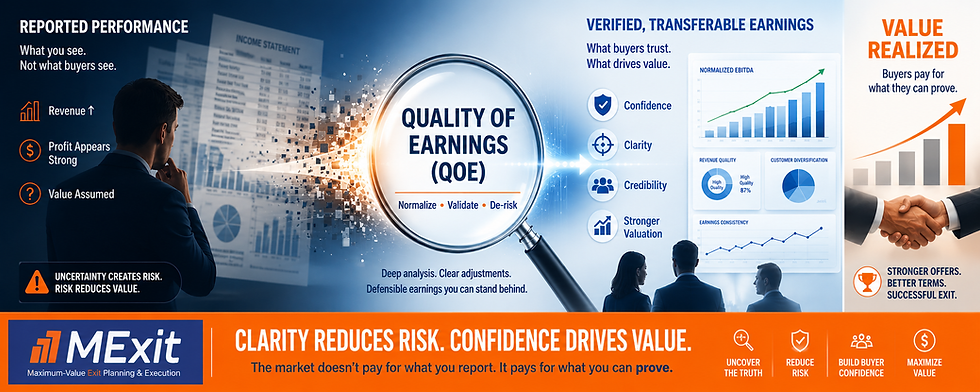
For many business owners, the expectation of value at exit is grounded in years of effort, growth, and financial performance. Revenue has increased, profits appear strong, and the business feels successful. On the surface, it seems reasonable to expect that a buyer will recognize that value and pay accordingly.
Sophisticated buyers do not solely rely on financial statements at face value. Instead, they focus on verified, sustainable, and transferable earnings. The difference between what an owner believes their business is worth and what a buyer is willing to pay often comes down to several critical factors, one of which is: confidence in the quality of earnings. This is where a Quality of Earnings (QOE) report becomes highly valuable.
What a Quality of Earnings Report Really Does
A Quality of Earnings report is not an audit, and it is not a simple review of financial statements. It is a detailed analytical review, often incorporating forensic techniques where appropriate that centers on one fundamental question:
“How much of this company’s earnings are real, repeatable, and likely to continue after the owner exits?”
A properly prepared QOE normalizes financial performance by:
Removing one-time or non-recurring revenue and expenses,
Adjusting for owner-specific compensation and discretionary spending,
Identifying revenue recognition inconsistencies,
Assessing customer concentration and revenue durability,
Evaluating margin sustainability, and
Highlighting operational or financial risks that could impact future earnings.
In essence, it bridges the gap between accounting profit and economically sustainable earnings used for valuation.
Why Buyers Rely on QOE to Determine Value
From a buyer’s perspective, valuation is not based on historical results alone. It is based on future cash flow they can rely on with confidence.
Even a highly profitable business may be discounted if:
Earnings are inconsistent or volatile,
Financial reporting lacks clarity or discipline,
Revenue is overly concentrated or uncertain,
Adjustments to EBITDA appear aggressive or unsupported, and
The business is dependent on the owner to sustain performance.
Without a QOE, these risks remain unresolved. Unresolved risk typically results in one or more of the following outcomes:
A lower valuation multiple
More conservative deal structures (earn-outs, holdbacks)
A failed transaction during due diligence
Buyers rarely pay premiums for uncertainty and instead price risk conservatively. They pay premiums for confidence.
The Hidden Gap Between Profitability and Value
One of the most common misconceptions among business owners is the belief that strong profitability automatically translates into high enterprise value.
It does not.
Two businesses with identical EBITDA can command dramatically different valuations based on the quality and reliability of those earnings.
A QOE exposes the difference between:
Reported EBITDA vs. normalized EBITDA,
Perceived performance vs. sustainable performance, and
Owner-dependent results vs. transferable results.
This distinction is critical as buyers place greater value on the second in each pair than the first.
Why Waiting for Buyer-Led QOE Is a Strategic Mistake
In many transactions, the QOE is commissioned by the buyer after a Letter of Intent (LOI) is signed. At that point, the owner has significantly less control over the narrative.
This creates several risks:
Reactive positioning: You are explaining issues instead of proactively addressing them,
Value erosion: Negative findings are often used to renegotiate price or terms,
Loss of leverage: The buyer controls the diligence process and interpretation, and
Deal fatigue: Surprises late in the process slow momentum and increase stress.
By contrast, conducting a seller-side QOE before going to market allows you to:
Identify and correct issues in advance,
Present clean, defensible financials,
Control the narrative around adjustments,
Reduce buyer uncertainty and accelerate diligence, and
Strengthen negotiating position.
In short, it shifts you from a defensive posture to a position of strength.
QOE as a Value Acceleration Tool, Not Just a Transaction Tool
Many owners view a QOE as something that happens during a sale. The most sophisticated owners use it as a tool well before they go to market.
When done early, a QOE can become a roadmap for value creation:
It highlights margin leakage and inefficiencies,
Surfaces customer or revenue risks that can be mitigated,
Identifies accounting practices that reduce credibility,
Creates a clear baseline for improving normalized EBITDA, and
Aligns financial reporting with buyer expectations.
This can support improvements in earnings quality and, in some cases, valuation multiples over time.
Given that valuation is typically a multiple of EBITDA, even modest improvements in normalized earnings and risk profile can have a disproportionate impact on enterprise value due to the combined effect of improved earnings and reduced perceived risk on valuation multiples.
The Role of QOE in Supporting a Defensible Valuation
A credible valuation is not built on optimism; it is built on evidence.
A QOE provides that evidence by:
Substantiating EBITDA adjustments with data,
Demonstrating consistency and predictability of earnings,
Validating revenue quality and customer behavior,
Providing transparency into financial performance drivers, and
Reducing perceived risk in the eyes of buyers and lenders.
This transforms valuation from a negotiation anchored in opinion into a discussion more grounded in data and evidence.
The Broader Impact on the Sale Process
Beyond valuation, a QOE can improve the entire transaction experience:
Faster due diligence: Fewer surprises and cleaner data,
Stronger buyer interest: Increased confidence attracts more qualified buyers,
Improved deal certainty: Reduced likelihood of re-trading or deal failure,
Better terms: Less reliance on earn-outs and contingencies, and
Professional positioning: Signals a well-run, well-prepared business.
In competitive processes, businesses with a seller-prepared QOE often stand out.
When a QOE Does NOT Increase Value
A Quality of Earnings report is a powerful tool, but it does not create value, it reveals it. Its role is to validate the quality and sustainability of earnings, not to manufacture them.
A QOE will not increase value when the underlying economics of the business do not support it. Instead, it clarifies the true earnings profile and associated risks. Common examples include:
Poor underlying performance: Inconsistent, declining, or non-recurring profitability is adjusted to reflect sustainable earnings.
Customer concentration: Heavy reliance on a small number of customers increases risk and typically leads to more conservative valuation assumptions.
Declining or unstable margins: Margin pressure and cost volatility raise concerns about future earnings durability.
Weak financial and operational systems: Inconsistent reporting or lack of controls reduces confidence in the numbers.
In these situations, a QOE does not diminish value, it clarifies it. The issue is not the QOE itself, but what it reveals. Without it, these risks still exist; they are simply discovered later, often during buyer-led diligence, where the consequences are more disruptive.
Used proactively, a QOE provides the opportunity to address issues, strengthen earnings quality, and improve readiness before going to market. Used reactively, it becomes a tool for buyers to validate concerns and adjust price or terms.
A QOE does not guarantee a higher valuation. It ensures the valuation is grounded in reality, and in a transaction environment where confidence drives value, clarity is an advantage.
Closing Thought: Confidence Drives Value
At exit, buyers are not simply acquiring your past performance; they are investing in the future performance of the business without you.
One of the most significant barriers to achieving your expected value is not lack of growth or profitability. It is lack of confidence in the durability of your earnings.
A QOE report helps address that barrier by improving transparency and confidence. It reduces uncertainty by increasing clarity, replacing skepticism with greater confidence, and grounding negotiation in validation. Because in the end, the market does not rely solely on what your financial statements report. It pays for what those earnings can pro
Comments